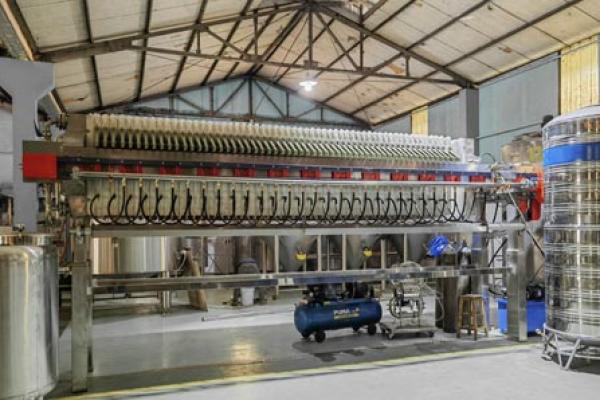


Membrane Filter Press
- 30-1000
- 870、1000、1250、1500、2000
- Auto/Semi-automatic/Manual
- Quick Open, etc.
- 0.8-4.0
- Visible/Invisible
Advantages:
-
Lower filter cake moisture
The membrane filter press adds a secondary squeezing process after pressure filtration. This helps extract more liquid from the filter cake and achieve lower cake moisture for suitable materials. -
High-pressure membrane squeezing
With high-pressure squeezing, the membrane plates can further compress the filter cake, improving liquid discharge efficiency and making the equipment suitable for deep dewatering projects. -
Shorter filtration cycle
For suitable sludge or slurry materials, membrane squeezing can help shorten the filtration cycle, improve processing efficiency, and increase overall production capacity. -
Better sludge volume reduction
Lower cake moisture means reduced sludge volume and weight. This can help customers reduce transportation, storage, and disposal pressure in wastewater treatment and industrial sludge projects. -
Flexible automation options
Manual, semi-automatic, and automatic operation modes are available. The equipment can be configured with automatic plate pulling, drip tray, cloth washing system, conveyor, hydraulic system, and PLC control according to project requirements. -
Suitable for high-solid slurry and difficult dewatering materials
Membrane filter press is suitable for materials that require stronger dewatering performance after primary filtration.
Selection Notes:
- Membrane filter presses incorporate additional components such as membrane plates and a pressing system, resulting in higher equipment procurement costs compared to conventional chamber filter presses.
- Membrane plates are wear-prone components that may age or become damaged after prolonged operation, requiring regular inspection and replacement.
- The membrane pressing process imposes strict requirements on parameters such as pressure and time, necessitating careful control of the operational workflow.
- Membrane filter presses are still classified as batch filtration equipment; in large-scale continuous production scenarios, their processing efficiency is somewhat limited.
Applications:
Applicable industries: Membrane filter press is widely used in environmental protection, wastewater treatment, chemical industry, mining and mineral processing, metallurgy, new materials, ceramics, food processing, medicine, and other industrial fields.
In wastewater treatment, it is suitable for municipal sludge dewatering, industrial sludge treatment, and projects requiring lower cake moisture and sludge volume reduction.
In mining and mineral processing, it can be used for tailings dewatering, mineral slurry filtration, coal slurry treatment, concentrate filtration, and resource recovery..
In the chemical industry, it is suitable for chemical wastewater treatment, pigment filtration, catalyst recovery, fine chemical filtration, and process material separation..
In metallurgy and new material industries, it can be used for metal sludge, battery material slurry, mineral powder slurry, and other high-solid slurry filtration..
In ceramics and building material industries, it is suitable for ceramic slurry, kaolin slurry, clay slurry, and other mineral slurry dewatering..
With secondary membrane squeezing and flexible configuration, the membrane filter press helps customers achieve deeper dewatering, lower transportation cost, easier disposal, and improved resource recovery.
Product Specifications:

3D Renderings:

FAQ:
1. What is a membrane filter press?
A membrane filter press is a highly efficient solid-liquid separation device that incorporates elastic membrane plates into a chamber-type filter press. By subjecting the filter cake to secondary compression through membrane inflation, it further reduces the moisture content of the filter cake and improves dewatering efficiency.
2. What is the working principle of a membrane filter press?
A membrane filter press first performs solid-liquid separation using a feed pump to form a preliminary filter cake; air or water is then introduced into the membrane to cause it to expand and compress the filter cake, further expelling residual moisture to achieve deep dewatering.
3. What is the difference between a membrane filter press and a conventional chamber filter press?
The main difference lies in the dewatering method: Chamber filter press: Relies primarily on feed pressure for filtration; Membrane filter press: Adds a membrane pressing step to the filtration process, providing secondary dewatering of the filter cake. Therefore, membrane filter presses typically produce filter cakes with lower moisture content.
4. Are the operating costs of a membrane filter press high?
Compared to conventional filter presses, membrane filter presses incorporate a membrane pressing system, resulting in slightly higher equipment investment. However, because they provide better dewatering performance, they can reduce subsequent costs such as sludge transportation and disposal.
Related Products
Related Cases